Pranit Mohnot

PhD student, Aeronautics & Astronautics, Stanford University · NSF Graduate Research Fellow

I am a PhD student at Stanford University, advised by Marco Pavone in the Autonomous Systems Lab. I work on physical AI and robot safety. My current focus is runtime safety for humanoid whole-body control. More broadly, I am interested in principled ways to make learning-based robot policies safe, reliable, and efficient without giving up their performance benefits. During my undergraduate studies at UC Berkeley, I first developed hardware and imaging systems for in-space 3D printing at the Design for Nanomanufacturing Lab, under the mentorship of Taylor Waddell and advised by Hayden Taylor. I then worked on robust optimal control for hybrid systems at the Hybrid Robotics Lab, under the mentorship of Jason J. Choi and advised by Koushil Sreenath.

I am seeking summer 2027 research internships in safety for physical systems, including but not limited to humanoid robots, and in hierarchical and agentic robot policies.

Contact me at p[lastname] at stanford dot edu.

Pranit Mohnot

Publications

Filter-Aware Fine-Tuning for Safe Humanoid Whole-Body Tracking
Mohnot, Helten, Gammelli, and Pavone
arXiv:2610.02341, 2026. Submitted to ICRA 2027. · paper

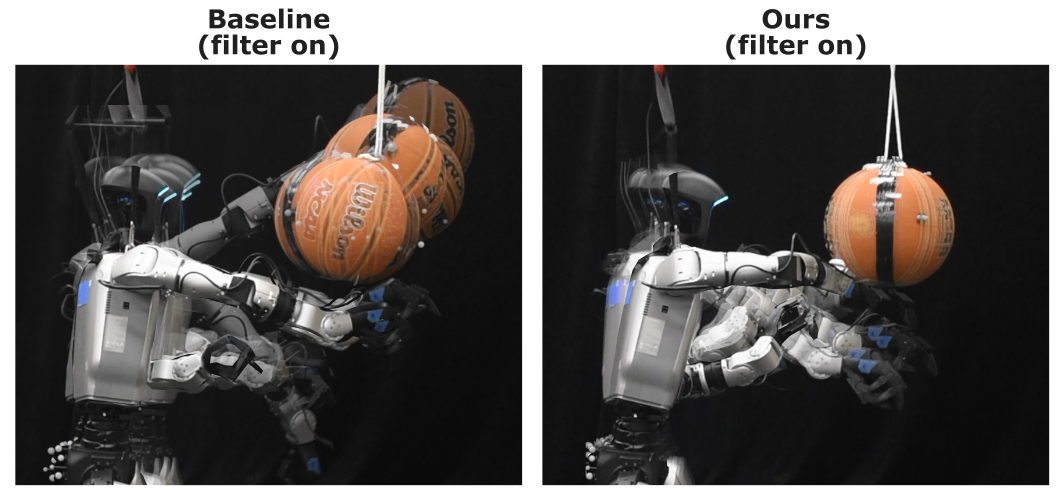
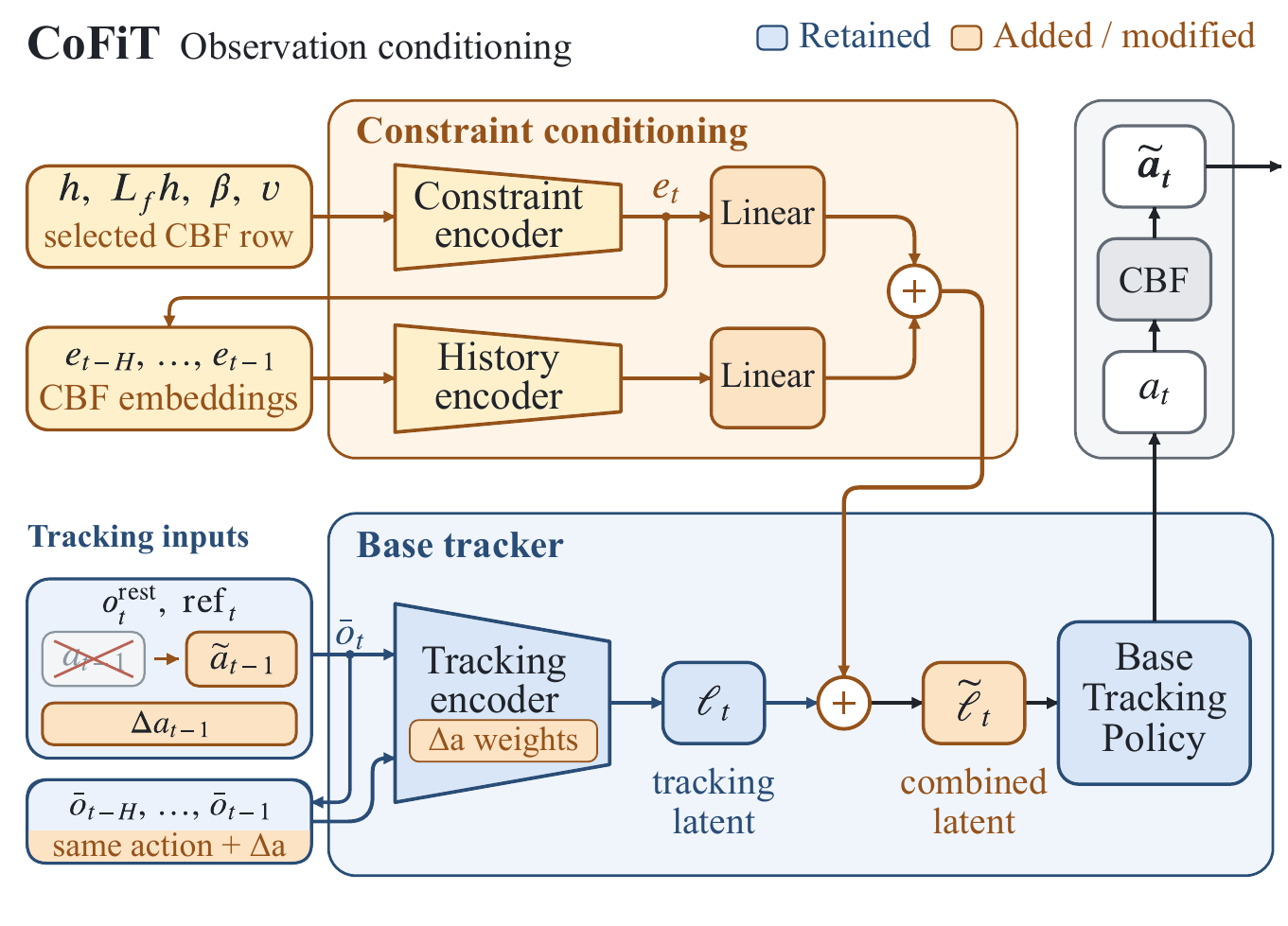
CoFiT fine-tunes pretrained humanoid motion trackers with a safety filter in the loop. Compared with filter-only training, it reduced violation time in simulation by 91% for TWIST2 and 21% for SONIC. On Unitree G1 hardware, it reduced violation time by 83% for TWIST2, and no trial needed an operator stop.

Constrained Whole-Body Tracking for Humanoid Robots
Morton, Mohnot, and Pavone
Conference on Robot Learning (CoRL), 2026 · paper · project page · code

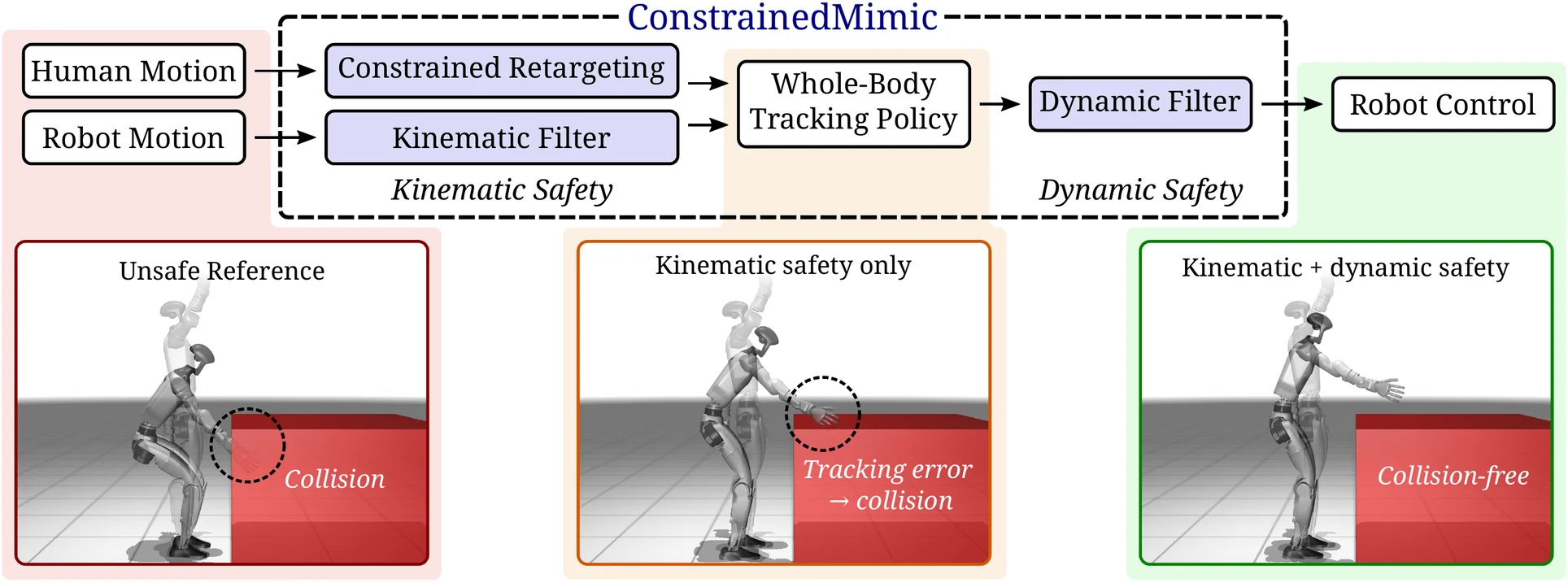
ConstrainedMimic enforces constraints specified at runtime on RL humanoid tracking policies, without retraining. Control barrier function filters act on the reference motion (kinematic safety) and on the policy's output (dynamic safety), at rates above 1 kHz.

Robust Hybrid Systems Differential Dynamic Programming for Worst-Case Disturbance
Mohnot*, Thirugnanam*, Choi*, and Sreenath (* equal contribution)
Preprint, 2023 · paper

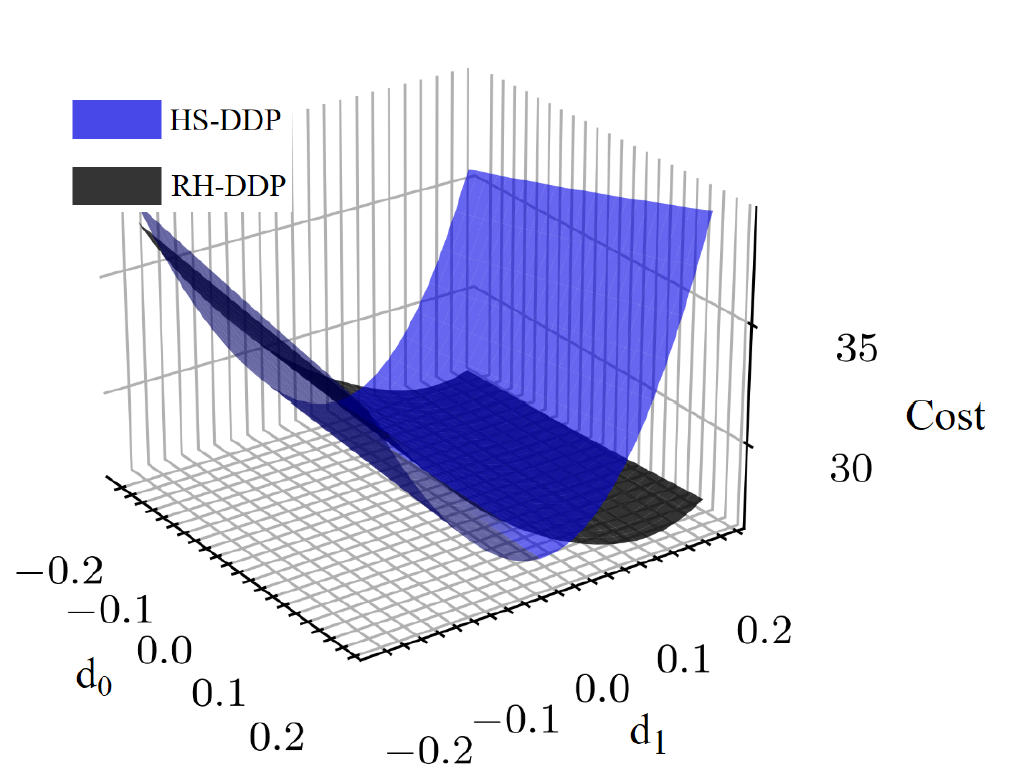
RH-DDP plans trajectories for legged robots that stay low-cost under the worst-case error in the impact (reset) dynamics.

3D surface plot of trajectory cost against two reset-map disturbance values for a two-link walker. The RH-DDP surface stays flatter and lower than the HS-DDP surface at the worst-case corner.
Use of Volumetric Additive Manufacturing as an In-Space Manufacturing Technology
Waddell, Toombs, Reilly, Schwab, Castaneda, Shan, Lewis, Mohnot, Potter, and Taylor
Acta Astronautica, Vol. 211, October 2023, pp. 474–482 · paper · project

SpaceCAL flew computed axial lithography, a volumetric 3D-printing process, on a parabolic microgravity flight in May 2022. A low-viscosity resin (0.12 Pa·s) printed with less geometric distortion in microgravity than on Earth.

Comparative Analysis of a Microgravity Computed Axial Lithography (CAL) System and a Gravity-Affected CAL System
Waddell, Toombs, Schwab, Mohnot, Reilly, Taylor, and Shan
International Astronautical Congress (IAC), Paris, 2022

Compares computed axial lithography printing in microgravity with the same process under gravity.

Teaching & Service